Yum Brands Sells Pizza Hut for $2.7 Billion: What the Deal Means for Franchisees and Investors

On June 16, 2026, Yum! Brands announced definitive agreements to sell Pizza Hut in a combined $2.7 billion transaction split across two buyers, ending nearly three decades of Yum ownership over one of the world's best-known pizza chains. The deal, confirmed by Yum's own investor relations release and covered by Reuters, CNBC, Fortune, and Yahoo Finance, is one of the biggest franchise-sector headlines of the past few weeks and carries real implications for current Pizza Hut franchisees, prospective investors watching the QSR space, and anyone tracking how private equity is reshaping restaurant franchising.
This article breaks down exactly what was announced, why Yum is divesting a brand it has owned since the 1990s, and what franchise investors should watch for as the deal moves toward closing.
The Deal at a Glance
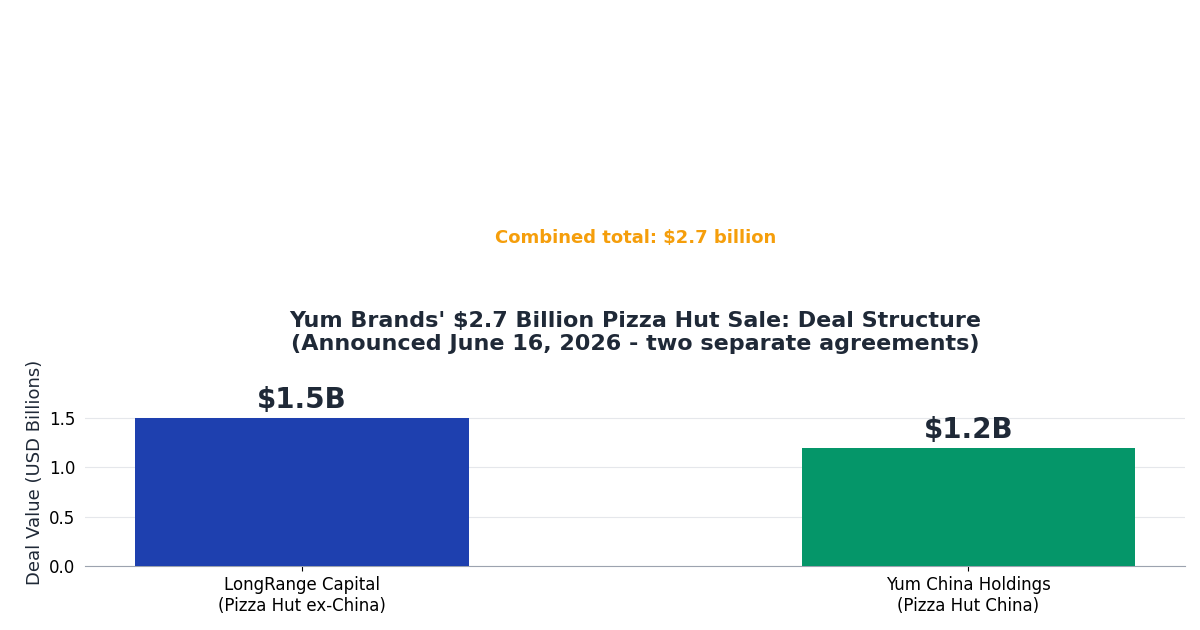
Yum Brands structured the sale as two separate agreements rather than a single buyer taking the entire global Pizza Hut system. LongRange Capital, a private equity firm, agreed to acquire Pizza Hut's business outside mainland China for approximately $1.5 billion. Separately, Yum China Holdings, the already-independent operator of KFC, Pizza Hut, and Taco Bell in mainland China, agreed to acquire full ownership of Pizza Hut's mainland China operations for the remaining portion of the combined $2.7 billion total.
Pro Tip: When a franchise brand changes ownership, your existing franchise agreement generally remains in force as written. The Item 1 (franchisor and its affiliates) and Item 20 (outlet and franchisee information) sections of your FDD are what will change going forward, not the contract terms you already signed.
Why Yum Brands Sold Pizza Hut Now
Multiple outlets covering the deal, including Reuters and Fortune, described Pizza Hut as the underperforming segment of Yum's three-brand portfolio, which also includes KFC and Taco Bell. Pizza Hut has faced sustained pressure from delivery-focused competitors and other QSR pizza chains with stronger digital ordering platforms, and its U.S. same-store sales have lagged behind Yum's other two brands in recent years.
Divesting a slower-growth brand allows Yum to concentrate management attention and capital on KFC and Taco Bell, both of which have posted stronger recent performance, while handing Pizza Hut to new owners with a specific mandate and fresh capital to attempt a turnaround. This kind of brand-focus divestiture is a familiar pattern in restaurant holding companies once a multi-brand portfolio becomes difficult to manage under one unified strategy.
A Brief History of Pizza Hut Under Yum Brands
Pizza Hut has been part of Yum Brands' portfolio since Yum's predecessor, Tricon Global Restaurants, was spun off from PepsiCo in 1997, bringing KFC, Taco Bell, and Pizza Hut together under one publicly traded restaurant holding company. Tricon was renamed Yum! Brands in 2002. Pizza Hut was, for much of that history, the flagship of the group, and it remains one of the most recognized pizza brands in the world with thousands of franchised and company-operated locations across the United States and dozens of international markets.
Over the past decade, however, the U.S. pizza category has grown considerably more competitive, with delivery-native chains and app-first ordering platforms reshaping how customers order. Pizza Hut invested in its own delivery and loyalty technology during this period, but multiple financial reporters covering the sale, including Reuters and Fortune, noted that its growth has trailed both KFC's and Taco Bell's within the Yum portfolio for several years running, which is widely cited as the central rationale behind Yum's decision to sell rather than continue investing in a turnaround internally.
Who Is LongRange Capital, and What Happens to Franchisees Outside China
LongRange Capital is a private equity firm now taking on Pizza Hut's global system outside mainland China, spanning company-owned and franchised units across the United States and other international markets. Private equity ownership of restaurant brands is not new. It typically means a defined hold period, a focus on operational efficiency and unit economics, and often a push toward remodeling, technology upgrades, or re-franchising of company-owned stores to franchisees to generate faster cash flow.
For existing U.S. Pizza Hut franchisees, the immediate practical impact of an ownership change is usually limited. Franchise agreements are contracts that survive a change in the franchisor's ownership; royalty rates, territory rights, and term length do not change automatically. What franchisees should watch for over the next 12-18 months is whether the new ownership group changes national marketing fund spend, technology platform requirements, or introduces new remodel or rebranding mandates as part of a turnaround strategy.
The Yum China Side of the Deal
Yum China Holdings, which has operated as an independent, separately-listed company since its 2016 spin-off from Yum Brands, is acquiring full ownership of Pizza Hut's mainland China operations as part of this transaction. Yum China already operates Pizza Hut restaurants in China under a master license, so this deal effectively consolidates full brand ownership for that market under the company that already runs day-to-day operations there. This split structure, rather than a single global buyer, reflects how differently the Pizza Hut brand performs and is positioned in China compared with the rest of the world.
How This Compares to Other Recent Restaurant Franchise M&A
The Pizza Hut transaction is one of several sizable ownership changes across the restaurant franchise sector in recent years, as private equity firms and strategic buyers continue to reassess which brands within larger multi-concept portfolios deserve dedicated capital and management focus. Multi-brand restaurant holding companies periodically divest a slower-growth concept to concentrate resources on their stronger performers, a pattern seen across the industry as portfolios mature and investor pressure for focused capital allocation increases.
For franchise investors, the pattern matters less as a single data point and more as a signal: brands that change hands through a private equity acquisition typically see a multi-year window of operational change, including possible remodel programs, technology platform migrations, or shifts in franchise development incentives designed to attract new franchisees into underpenetrated markets. Watching how LongRange Capital approaches Pizza Hut's system over the next 12-24 months will likely offer a preview of how it plans to generate returns on its $1.5 billion investment.
What This Means If You're a Current or Prospective Pizza Hut Franchisee
- Request an updated FDD once the deal closes. Item 1 (the franchisor entity) and Item 3 (litigation) will reflect the new ownership structure.
- Ask your franchisee association or existing franchisee contacts whether LongRange Capital has communicated any near-term strategy changes.
- Watch national marketing fund contribution levels closely in the first year after close, since new ownership groups sometimes adjust this spend as part of a broader repositioning.
- If you are considering buying an existing Pizza Hut location, factor the ownership transition into your due diligence timeline and ask the seller directly about any communicated changes from the new franchisor.
- Track same-store sales trends reported after the transition, since a private-equity-backed turnaround plan will typically show up first in same-store sales data before it shows up in franchisee disclosures.
Broader Signal: Private Equity's Growing Appetite for Restaurant Brands
The Pizza Hut sale fits a broader pattern of private equity firms acquiring mature, well-known restaurant and franchise brands that a larger multi-brand parent has decided to divest. These deals typically follow a similar playbook: acquire a recognizable brand with a large existing franchise base, invest in operational improvements and technology, and either reposition the brand for growth or prepare it for a future sale or public listing. For franchise investors, this trend matters because it signals which categories are attracting institutional capital and can affect the pace of remodeling requirements, technology fee changes, and marketing investment across an entire franchise system over the following several years.
What Prospective Franchise Investors Should Watch Next
Franchise investors evaluating a Pizza Hut location, or any brand undergoing a similar ownership transition, should treat the months immediately following a close as a distinct due diligence window. Request the most recently amended FDD rather than relying on pre-transaction disclosures, and pay close attention to Item 20's outlet transfer and closure data during the transition period, since ownership changes can sometimes accelerate underperforming unit closures as part of a portfolio cleanup. It is also worth asking directly whether the new ownership group has committed to maintaining, increasing, or reducing system-wide advertising fund spend, since that single line item has an outsized effect on individual unit sales.
Timeline: What Typically Happens Between Announcement and Close
Deals of this size generally take several months to close after the initial announcement, pending regulatory review and customary closing conditions. During this interim period, franchisees typically continue operating under existing terms, and the current management team generally stays in place to ensure a smooth operational handoff. It is common for franchisors to communicate directly with their franchisee associations well before a public FDD update is filed, so joining or staying active in your regional or national Pizza Hut franchisee association is one of the more reliable ways to get early signal on what is changing.
Once the deal closes, expect an updated FDD to follow within the following renewal cycle in most states, since franchisors are required to disclose material changes in ownership. Prospective buyers evaluating an existing Pizza Hut location during this transition window should request the most recent available disclosure and ask the seller directly whether they have received any communication from the incoming ownership group about future system changes.
Conclusion
The $2.7 billion sale of Pizza Hut marks the end of nearly 30 years of Yum Brands ownership and hands the chain to two very different buyers with two very different mandates: a private equity firm focused on operational turnaround outside China, and Yum China consolidating full ownership of a market it already runs. For current and prospective franchisees, the fundamentals of good due diligence do not change just because the news is bigger than usual: request the updated FDD once it is filed, talk to existing franchisees about what has changed on the ground, and watch the marketing fund and remodel requirements closely over the next year as the new ownership structure settles in.
Get insider access to franchise insights
Subscribe to receive expert tips, franchise rankings, and exclusive data straight to your inbox, trusted by thousands of aspiring business owners and investors.
Franchise resources & insights
Explore expert guides, data-driven articles, and tools to help you make smarter franchise decisions, whether you're just starting out or ready to invest.