Staffing and Recruiting Franchises in 2026: Costs, Earnings, and Why the Market Reset Matters

Staffing and recruiting franchise investment overview for 2026, showing US staffing market size and franchise cost range.
Most franchise buyers start by picturing a storefront. A staffing franchise has no storefront, no inventory, no drive-thru window, and no Saturday rush, and that is precisely why a growing number of investors are looking at it.
The category sits in a strange position heading into late 2026. The U.S. staffing industry is expanding again, but slowly, and it remains far below the hiring frenzy of 2022. That combination scares off speculators and rewards operators who understand the model. For a franchise investor evaluating business-to-business concepts, staffing offers something the consumer categories rarely do: contract-based recurring revenue, six-figure average client relationships, and an asset-light footprint that fits inside a modest office suite.
This guide breaks down what staffing and recruiting franchises actually cost in 2026, what the published financial performance data shows, how the major brands differ, and who this category genuinely suits. We will also be honest about the parts of the model that trip up new owners, because staffing is a sales business first and a franchise second.
The 2026 Staffing Market: A Reset, Not a Collapse
Understanding the category requires understanding where the industry is in its cycle.
Staffing Industry Analysts (SIA), the sector's primary research body, projects U.S. staffing revenue of approximately $183.1 billion in 2026, representing roughly 2.4% growth over 2025 in its September 2026 update, an upward revision from the roughly 1% growth SIA had forecast earlier in the year. SIA projects further expansion of about 2.2% in 2027.
Two things stand out in those numbers.
First, the market is growing again after a multi-year contraction. Second, it is still well below the $243.9 billion peak recorded in 2022, when post-pandemic labor scarcity pushed bill rates and volumes to unsustainable highs. The industry is not recovering toward that peak; it is resetting to a more normal baseline.
That distinction matters for a franchise buyer. Anyone modeling returns off 2022 comparables will be disappointed. Anyone modeling off 2026 conditions is working from a realistic floor.
Where the Demand Actually Is
Growth inside the category is uneven. Temporary staffing overall is forecast at roughly 0–1% growth, essentially flat, while the total number of temporary employees is estimated to reach about 2.8 million in 2026.
The segments franchise operators consistently identify as strongest heading into 2026:
- Healthcare staffing, nursing, allied health, and clinical support roles, where structural shortages persist regardless of the economic cycle
- Industrial and light manufacturing, reshoring activity and warehouse turnover keep volume steady
- Skilled trades, electricians, HVAC technicians, and welders, where the retirement wave outpaces new entrants
- Professional and administrative, the slowest-recovering segment, and the most exposed to AI-driven task automation
A franchisee's territory and vertical focus will drive results far more than the brand on the door.
The AI Question
Every staffing conversation in 2026 eventually reaches artificial intelligence, and the honest answer is that it cuts both ways.
Recruiters report that AI tools are compressing sourcing time and improving candidate-to-role match quality. Roughly 61% of recruiters expect time-to-fill to hold steady in 2026, with another 15% expecting it to improve as candidate supply and employer demand realign.
At the same time, AI is eroding demand for exactly the entry-level administrative and data-entry placements that once formed the base of many staffing desks. The franchisees who thrive are the ones using AI to widen margins on skilled placements, not the ones defending commodity clerical volume.
What Staffing Franchises Cost in 2026
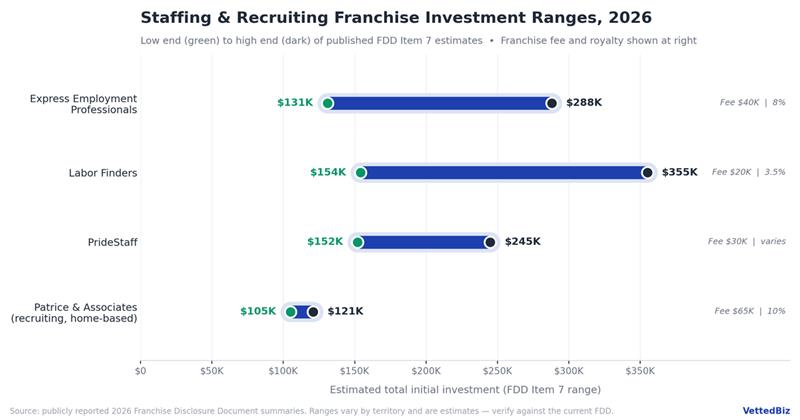
Staffing franchises span a wider investment range than most categories, because the models underneath them are genuinely different.
Why the Range Is So Wide
Three structural differences explain the spread.
Payroll funding. Temporary staffing franchisors front the wages of placed workers, then collect from the client on 30-to-60-day terms. Some brands finance that gap centrally; others push it to the franchisee, which dramatically changes working-capital requirements. This is the single most important line item to understand before signing.
Office footprint. A full-service temp office needs street-accessible space, interview rooms, and often on-site orientation capacity. A direct-hire recruiting franchise can run from a home office with a laptop and a phone.
Direct hire versus temporary. Recruiting-only models like Patrice & Associates collect a placement fee, typically a percentage of first-year salary, and carry no payroll liability. That lowers entry cost and risk, but also removes the recurring revenue that makes temp staffing attractive at scale.
Ongoing Costs Beyond Royalties
Budget for these regardless of brand:
- Workers' compensation and employer liability insurance on temporary workers, a material and volatile cost in industrial verticals
- Applicant tracking and payroll technology fees, often charged per user or per placement
- Local marketing and job-board spend, frequently underestimated by first-year owners
- Background screening and compliance costs, especially in healthcare placements
Pro Tip: Ask specifically how workers' compensation experience modifiers are handled when you take over an existing book of business. A single serious claim in an industrial territory can reshape your cost structure for years.
Revenue and Earnings: What the Data Shows
This is where staffing franchises separate themselves from most low-cost service concepts.
Express Employment Professionals reports in Item 19 of its Franchise Disclosure Document an annual gross sales of $3,940,677.
That headline number requires context, and the context is important.
Sales are not profit. In temporary staffing, reported "sales" is gross billings, the full amount invoiced to clients, including the wages paid to placed workers. Gross margin on temporary placements typically runs in the 20–30% range depending on vertical and bill rate. Even a million dollars in first-year billings might translate to $200,000–$300,000 in gross profit, against which you still pay rent, internal staff, insurance, technology, and royalties.
Direct hire economics invert this. A recruiting franchise placing candidates at a 20–25% fee on a $90,000 salary earns $18,000–$22,500 per placement with almost no cost of goods. Billings look far smaller; margin looks far better.
Comparing a temp brand's billings to a recruiting brand's revenue is an apples-to-oranges error, and it is the most common mistake buyers make in this category.
A Realistic Ramp
Staffing is a relationship business with a long sales cycle. Most operators describe a pattern along these lines:
- Year 1, heavy prospecting, building the client list and candidate pipeline; often break-even or a loss
- Year 2, repeat orders from established accounts begin compounding; owner compensation becomes meaningful
- Year 3 and beyond, a stable base of recurring accounts, with growth coming from adding recruiters rather than adding clients one at a time
That trajectory should shape your capital planning. Underfunding the first eighteen months is the most common cause of failure in this category.
The Competitive Landscape
Franchised staffing offices do not compete only with each other. They compete with Adecco, ManpowerGroup, and Randstad, global firms with national account contracts and enterprise procurement relationships.
Franchisees generally cannot win on price or scale against those players. They win on local depth: knowing which warehouse managers hire in which months, which nursing supervisors need weekend coverage, and which candidates will actually show up on Monday.
This has a practical implication. If your territory is dominated by a handful of large employers who buy staffing through centralized national contracts, the local franchise model works poorly. If your territory is a dense mid-market, regional manufacturers, independent clinics, growing contractors, the model works well.
Evaluate the employer composition of your territory before you evaluate the brand.
Pros and Cons of Staffing Franchise Ownership
Advantages
✅ Recurring revenue. Once a client is placing weekly orders, revenue compounds without repeated selling.
✅ No inventory or physical product. Working capital goes into payroll funding, not perishable goods or equipment.
✅ Scalable through people. Growth comes from adding recruiters, not building new locations.
✅ Counter-cyclical elements. Employers often shift toward temporary labor during uncertainty, softening downturns.
✅ B2B hours. Most offices operate weekday business hours, a meaningful lifestyle difference from food or retail.
Challenges
❌ It is a sales business. If you will not prospect and cold-call, this category is not for you, regardless of brand support.
❌ Working capital intensity. Funding payroll before client payment is the defining financial constraint of temp staffing.
❌ Employment law exposure. You are a co-employer, with attendant classification, wage-and-hour, and workers' compensation risk.
❌ Cycle sensitivity. Staffing leads the economy down and lags it coming back up.
❌ Talent dependency. Your internal recruiters are the product; turnover among them directly hits revenue.
Who This Category Actually Suits
Staffing and recruiting franchises tend to work for buyers who fit a fairly specific profile.
Strong fit: former sales leaders, HR and talent acquisition professionals, corporate managers with local business networks, and investors seeking a B2B model with professional hours and no consumer foot traffic. It also appeals to buyers who want a business that scales through hiring rather than through additional real estate.
Poor fit: buyers seeking semi-absentee ownership. Staffing is not a passive category, the owner is the primary business developer for at least the first two years. It is also a poor fit for buyers who are undercapitalized, because the payroll funding gap punishes thin balance sheets quickly.
For international investors: the category's B2B nature, W-2 employment footprint, and documented capital requirements often align well with visa-based investment structures, though the specifics depend entirely on individual circumstances and should be reviewed with qualified immigration counsel.
How to Evaluate a Staffing Franchise
Before you sign, work through this sequence.
- Read Item 7 line by line and identify exactly how much of the range is working capital versus fixed startup cost.
- Ask directly who funds payroll and on what terms, this single answer reshapes your entire financial model.
- Read Item 19 carefully, distinguishing gross billings from gross profit and checking which cohort of franchisees the figures describe.
- Call at least ten current franchisees from the Item 20 list, including at least two in territories similar to yours in size and industry mix.
- Analyze your territory's employer base, mid-market density beats total population every time.
- Confirm the workers' compensation structure and how claims history affects your rates.
Conclusion
Staffing and recruiting franchises are not the easiest business to own, and 2026 is not a boom year for the sector. What the category does offer is a rare combination in franchising: recurring B2B revenue, asset-light operations, professional hours, and a market resetting from an unsustainable peak toward a stable, growing baseline of roughly $183 billion.
The investment range is wide, from about $90,000 for a home-based recruiting franchise to more than $500,000 for a full-service staffing office, and the two ends of that range are genuinely different businesses with different economics and different risks.
If you are a relationship-driven seller with adequate working capital and a mid-market territory, this is a category worth serious diligence. If you are looking for passive income or a business that runs without you selling, look elsewhere.
Next step: pull the current Franchise Disclosure Documents for two or three brands in this category, compare Item 7 and Item 19 side by side, and start your Item 20 franchisee calls before you fall in love with a brand.
Sources: Staffing Industry Analysts U.S. Staffing Industry Forecast (September 2026 update); publicly reported 2026 Franchise Disclosure Document summaries; International Franchise Association (franchise.org). Investment figures are estimates that vary by territory and should be verified against the current FDD provided to you.
Get insider access to franchise insights
Subscribe to receive expert tips, franchise rankings, and exclusive data straight to your inbox, trusted by thousands of aspiring business owners and investors.
Franchise resources & insights
Explore expert guides, data-driven articles, and tools to help you make smarter franchise decisions, whether you're just starting out or ready to invest.